
Many Chicagoland solar pages still read like it’s 2022, highlighting “30% federal credit, full net metering, and payback in X years.”
That is not how it works anymore in ComEd territory after January 1, 2025, and it is why homeowners get wildly different payback quotes for the same size system.
If you’re estimating solar payback Chicagoland, the most reliable approach is to stack incentives correctly and show the math clearly.
Before installing solar, it’s worth confirming your roof has plenty of remaining life so your system can run smoothly for years.
If a roof replacement is on the horizon, handling it upfront helps keep the installation simple and protects your overall project value. See our guide on how much a new roof costs in Chicago for your peace of mind.
In ComEd territory across Chicagoland, the payback timeline is anchored to Permission to Operate, and the DER interconnection process (including any distribution upgrades) can influence that start date just as much as panel choice.
This guide clearly breaks down Illinois Shines SRECs, ComEd’s supply-only export credits (post-2025), and the federal rules that vary based on ownership structure and placed-in-service date, so you can confidently estimate savings with today’s real-world incentives.
Key Highlights
- ComEd rules changed the payback math after January 1, 2025. New net metering customers get supply-only credits for exported solar, which makes self-consumption (using more power in your home) more valuable than exporting.
- Illinois Shines SRECs are still a major early value driver. For many homeowner-sized systems (Small DG), the incentive is delivered as a 100% upfront payment at energization, with timing coordinated through invoicing and processing.
- Federal credits depend on ownership and timing. Homeowner-owned systems placed in service after December 31, 2025 should not assume a federal residential solar credit, but third-party owned or commercial projects may still qualify for business credits.
- The Domestic Content Bonus most commonly comes up in business or third-party ownership structures. When the project owner meets the domestic content requirements, it can increase the owner’s federal credit value, and it’s typically evaluated at the project/owner level rather than as a standard add-on for homeowner-owned rooftop installs.
- Real Palatine example shows the math, not guesses. A $30,000 SolarEdge system modeled with Illinois Shines pricing, ComEd supply-only export credits, and a transparent self-use vs export split lets you sanity-check your quote and compare installers using the same yardstick.
- Your biggest payback levers are controllable. Accurate production estimates, realistic export percentage assumptions, and real bill inputs (supply vs delivery) often move payback more than small differences in equipment pricing.
Is Solar Still Worth It in Illinois in 2026?
Yes, solar remains a highly profitable investment in Illinois in 2026.
While the transition to supply-only net metering (post-January 1, 2025) changed how export credits are calculated, the combination of Illinois Shines (SREC) payments, the 30% Federal Tax Credit, and ComEd’s Distributed Generation (DG) rebates still allows most Chicagoland homeowners to achieve a full payback within 8 to 12 years (see our detailed 2025 payback breakdown).
In a typical SolarEdge-optimized system, the total return on investment significantly outpaces rising utility rates.
The Incentive Stack in Chicagoland
If you are pricing SolarEdge in the Chicago suburbs, the payback story usually comes from three buckets that can stack:
- Illinois Shines SRECs: It is a state incentive paid through your installer or an Approved Vendor.
- ComEd bill credits: You earn credits for excess solar you export to the grid, and the exact rules depend on when your system is enrolled.
- Federal credits: These can add meaningful value, but they depend heavily on ownership (homeowner-owned vs third-party owned) and the system’s placed-in-service date, so aligning the project structure early helps you capture the best available benefit.
Below is a breakdown of the stackable incentives in Chicagoland, who qualify for them, their payment method, and when customers receive them.
People often search for SolarEdge Illinois tax credit, but the real savings usually come from a mix of Illinois Shines SRECs, ComEd bill credits, and federal credits, which depend on who owns the system.
For a clear, authoritative overview of eligibility, payment structure, and how the program works, the Illinois Shines 2025–26 Program Guidebook is the best reference.
Stacking Incentives in Two Scenarios
Solar incentives don’t stack the same way for everyone in Chicagoland, so the fastest way to avoid a misleading quote is to first identify which situation you’re in: you either own the system yourself (cash or loan), or it’s owned by a third party or a business (lease, PPA, or commercial ownership).
The two scenarios below show which incentives typically apply in each case and, just as importantly, which ones usually don’t, so you can compare quotes with confidence.
Scenario 1: Homeowner-owned in 2026 (cash or loan)
If you buy and own the system in 2026, the incentive stack is usually simple. You can combine Illinois Shines SRECs with ComEd bill credits, but you should not count on a federal residential tax credit if your system is placed in service after 2025.
- Illinois Shines SRECs are paid through a REC Delivery Contract, and for Small DG, they’re commonly paid 100% upfront at energization, with payment issued after invoicing and standard program processing.
- ComEd export credits applied to your bill, with new net metering customers after January 1, 2025, receiving credits that offset charges in the Supply section of the bill.
- Per the IRS Residential Clean Energy Credit page, the federal residential solar credit is not available for property placed in service after December 31, 2025, so projects completed by that date can still take advantage of it.
Before you sign, make sure your quote clearly shows the SREC assumptions and timing and models ComEd savings using the post-2025 export credit rules, so your payback timeline is built on numbers you can verify with confidence.
Scenario 2: Third-Party Owned or Commercial (Lease, PPA, or Business-Owned)
If the system is owned by a third party or a business, the stack can include additional federal benefits.
In this setup, Illinois Shines SRECs can still apply at the project level through the same REC contract structure, and ComEd export credits can still apply on the utility bill under the post-2025 Supply-section credit rules for new customers.
- Illinois Shines SRECs continue to apply at the project level through the program’s REC contract structure, helping add meaningful value to qualifying installations.
- ComEd export credits still apply on the utility bill under the post-2025 Supply-section credit structure for new customers.
- Federal business credit may apply to the owner (for example, the Clean Electricity Investment Credit is described by the IRS as available to businesses and other entities that invest in qualifying projects).
- Domestic Content Bonus may apply to increase the owner’s federal credit amount if domestic content requirements are met (this is an additional incentive under ITC and PTC for businesses and other entities). To confirm how ComEd applies credits starting January 1, 2025, the ComEd Net Metering FAQ is a helpful reference.
In a lease or PPA, the federal credit is typically claimed by the system owner, which helps support competitive pricing and lower monthly payments for the homeowner.
Real example: What a $30K SolarEdge System Nets You in Palatine, IL
To benchmark SolarEdge Chicago cost, we will use a simple example: a $30,000 SolarEdge system in Palatine before incentives.
Below is a transparent, step-by-step example you can sanity-check. You can see the math, swap in your real ComEd bill rates, and immediately understand your payback drivers.
A credible Chicagoland model brings together the Residential Clean Energy Credit (25D) and Illinois Shines (Adjustable Block Program) REC cashflows (1 REC per 1,000 kWh), then translates those inputs into clear outcomes using NPV/IRR, a realistic degradation rate, and practical O&M expectations.
Assumptions
These assumptions provide a clear baseline for the example, making it easy to follow the math and plug in your own numbers.
Location
This example uses Palatine, IL in ComEd’s service territory, making it a great match for how many Chicagoland quotes are modeled (in Illinois Shines, ComEd territory projects are categorized as Group B).
System
In this Palatine example, the system is priced at $30,000 before incentives, and it includes a SolarEdge inverter with optimizers plus panels.
While the brand choice doesn’t automatically change eligibility for Illinois Shines or ComEd credits, it can meaningfully improve production estimates, monitoring, and long-term serviceability.
Sizing and Production (Example Inputs)
For the Illinois Shines math, we use the inverter’s AC size. In this example, the inverter size is 7.6 kW AC, which equals 0.0076 MW AC.
Estimated annual production is 9,600 kWh/year, and you can easily estimate your own by running your address and system size through NREL PVWatts or by using your installer’s production model.
Household Usage
In this example, the home uses about 750 kWh per month (roughly 9,000 kWh per year), which is a helpful baseline for estimating savings.
ComEd Rate Inputs
To model export credits, this example uses ComEd’s Price to Compare as a supply benchmark. The state’s posted ComEd Price to Compare effective January 1, 2026, is 9.6 cents per kWh.
For delivery charges and fees, this example uses a placeholder of 6.0 cents per kWh. You should replace this with the delivery portion on your actual bill.
This works well because post-2025 export credits for new customers are supply-only, so maximizing self-consumption is a great way to capture the full value of your solar production.
Export Percentage Assumption (Post-2025)
This example assumes 65% of solar production is used in the home (self-consumed), and 35% is sent to the grid (exported), which is a great way to model real-world usage.
Since Illinois’ updated net billing rules for new customers start January 1, 2025, self-consumed kWh typically deliver the most value by offsetting both supply and delivery, while exported kWh are generally credited at the supply rate, making smart sizing and self-use strategies especially rewarding.
Step-by-Step Calculation
The step-by-step calculation below makes Chicagoland solar payback easy to verify by breaking it into four clear parts: your gross installed Palatine solar cost, the Illinois Shines SREC value, your monthly ComEd bill impact (self-use vs exports), and the federal incentive scenario that fits your ownership structure and placed-in-service date.
Each step shows the exact inputs and math so you can swap in your real bill rates and production estimate and see how solar payback in Chicago suburbs changes.
Step 1: Determine the gross Chicago suburb solar cost.
The gross cost is simply the starting installed price before incentives, and in this example, the SolarEdge system is $30,000.
Step 2: Subtract the Illinois Shines SREC value (and show the estimate).
Before we subtract anything, a quick definition of the terms keeps the math clear, consistent, and easy to follow.
An SREC (solar REC) is a Renewable Energy Credit, and one REC represents the environmental value of 1 MWh of renewable electricity your system produces. Illinois Shines is the Illinois program that pays for these credits through REC delivery contracts.
For many homeowner-sized projects (Small DG), Illinois Shines is designed to deliver a 100% upfront payment at Energization, based on the program’s contract structure in the Guidebook.
Here’s how we estimate the Illinois Shines SREC value for this Palatine example (ComEd territory, Group B):
- Convert inverter size to MW AC.
- 7.6 kW AC = 0.0076 MW AC
- Estimate the capacity factor using annual production.
- Annual production = 9,600 kWh ÷ 1,000 = 9.6 MWh
- Annual MWh also equals MW × 8,760 × capacity factor
- Capacity factor ≈ 9.6 ÷ (0.0076 × 8,760) ≈ 0.144
- Estimate total RECs over 15 years.
- 9.6 MWh per year × 15 years = 144 RECs
- Apply the Illinois Shines REC price for the right group and size.
- Group B (ComEd), 0–10 kW AC: $75.48 per REC
- Calculate the estimated SREC value.
- 144 RECs × $75.48 ≈ $10,869
In this example, the Illinois Shines SREC value comes out to about $10.9K, which is a meaningful boost to overall savings and is often shown as a line item because installers typically handle the REC process.
Illinois Shines uses an approved capacity factor, and this example estimates it from PVWatts-style annual production to keep the math transparent and easy to verify.
Step 3: Add the monthly bill savings model (import reduction + export credits).
For ComEd customers, the value of solar savings comes from two places: the energy you use directly in your home, and the energy you export back to the grid.
Key rule (post-2025): For new net metering registrations, bill credits shift to supply-only starting January 1, 2025, which makes self-consumption especially valuable. That means exported power is usually worth less than the power you use on-site because on-site usage avoids both supply and delivery charges, so your best savings often come from using more of your solar energy at home.
Break the production into two parts (example assumption):
- Annual production: 9,600 kWh
- Self-consumed (65%): 9,600 × 0.65 = 6,240 kWh
- Exported (35%): 9,600 × 0.35 = 3,360 kWh
Rate assumptions for this example (replace with your actual bill):
- Supply benchmark: $0.096 per kWh
- Delivery placeholder: $0.060 per kWh
- Retail value of self-consumption: $0.096 + $0.060 = $0.156 per kWh
Estimated annual bill impact:
- Self-consumption value: 6,240 × $0.156 = $973
- Export value (supply-only proxy): 3,360 × $0.096 = $323
- Total estimated annual savings: $1,296 per year
Step 4: Apply the federal incentive scenario (only for the path that qualifies).
Federal incentives depend on ownership and timing, and the IRS notes that for homeowner-owned systems, the Residential Clean Energy Credit applies to property placed in service through December 31, 2025, helping clarify which projects can still take advantage of it.
To keep this Palatine example clear, here are two scenarios:
Scenario A: Placed in service by December 31, 2025 (homeowner-owned)
- Model federal credit as 30% of $30,000 = $9,000 (subject to your tax situation)
Scenario B: Placed in service in 2026 (homeowner-owned)
- Model federal residential credit as $0 (based on current IRS language)
Based on these assumptions, this example shows how solar payback Chicagoland changes when you separate self-consumption savings from supply-only export credits and apply only the incentives that actually qualify.
Solar Payback Visualization
Here’s a simplified payback snapshot that shows how a $30,000 upfront solar investment can turn into positive lifetime cash flow when incentives hit early, and savings continue over time:
Year 0 marks the $30,000 investment that launches the system’s payback journey.
Year 1 delivers the biggest jump because it combines multiple incentives (SRECs, the federal credit, and a rebate), significantly reducing the gap to breakeven.
After that, the model reflects ongoing electricity savings that increase over time as utility rates rise, which is why the annual savings shown grow from about $1,200 to $2,200 by Year 25.
Under these assumptions, the project reaches positive cumulative cash flow in Year 9 (the break-even point) and then continues building net value through the remaining system life.
Overall, the data shows a familiar pattern: incentives accelerate early progress, rising savings support long-run value, and by Year 25, the model totals roughly $31,500 in net profit.
ComEd Net Metering After January 1, 2025: What Changed and How It Affects Solar Payback
For Illinois homeowners enrolling after January 1, 2025, the shift from full retail net metering to supply-only export credits changes the value of overproduction, so pairing SolarEdge power optimizers (MLPE) with accurate kWh modeling and a right-sized DC/AC ratio becomes a key part of getting the economics right.
If your Palatine home is in ComEd territory, the biggest payback shift is how exported solar is credited, which makes self-consumption especially rewarding.
Under the new rules, exporting a lot of power is usually less valuable than using that power in your home, since self-use captures more of the bill savings.
The Change
New DG customers registering on and after January 1, 2025, receive energy supply credits for excess generation (rather than full retail net metering), which makes maximizing on-site solar use an especially effective way to boost overall savings.
ComEd states that customers who interconnected by December 31, 2024, can keep full retail net metering for the life of the system (legacy status), offsetting charges in all sections of the bill (supply, delivery, and taxes and fees), unless the system is modified in a way that requires a new interconnection application.
What That Means For Your System Design
After 2025, ComEd’s supply-only export credits make how you use your solar just as important as how much you produce.
This section explains why self-consumption now drives a bigger share of savings, how batteries can improve both economics and backup, and simple load-shifting habits that help you capture more value from the same system.
Why Self-Consumption Matters More Now
With supply-only net metering, you still pay delivery charges on the electricity you pull from the grid, even if you exported plenty of solar earlier in the day, so using more of your solar on-site becomes an even bigger win.
Illinois Shines describes this as supply “netting,” while delivery charges can still apply to the full amount of electricity you import from the grid, making self-consumption a smart way to maximize value.
If your home runs hot in summer, improving attic airflow can reduce cooling demand and help you use more solar on-site. Get the essentials on roof vent installation, plus a daylight-powered option in our solar attic fan installation guide.
The practical takeaway is simple: the more of your solar you use on-site, the more value you capture.
When Batteries Move From “Backup Only” to “Economics + Backup”
A battery can store midday overproduction and discharge it later when your home is using power, but the sun is down. That helps you avoid buying as much electricity from the grid in the evening, which is often more valuable than exporting those kWh for supply-only credits.
Batteries still provide outage protection, but after 2025, they can also improve the economics by increasing self-consumption.
Load Shifting Ideas
If you do not want a battery (or before you add one), shifting flexible loads into solar-producing hours can increase self-consumption:
- Charging EV midday (or late morning to afternoon) instead of overnight.
- Scheduling the heat pump to pre-heat or pre-cool during sunny hours so the system runs less after sunset.
- Timing electric water heating to run during the day so hot water is “stored” as heat rather than exported electricity.
- Appliance batching (dishwasher, laundry, drying) during peak solar hours when possible.
These changes don’t alter ComEd’s credit rules, but they do increase how much of your solar is used in-home versus exported, one of the biggest drivers of Chicagoland solar payback under supply-only credits.
Federal Illinois Solar Incentives: What Applies Now

Federal and Illinois solar incentives depend on who owns the system and the year it’s placed in service, so we break them down by scenario.
In this section, we’ll show how to avoid the most common Chicagoland pricing pitfall (i.e., quotes that assume a federal credit you may not qualify for) so your numbers stay accurate, expectations stay aligned, and trust stays high from day one.
Homeowner-Owned Systems (Buy With Cash/Loan)
If you buy the system (cash or a standard loan) and you own it, the federal incentive people usually mean is the Residential Clean Energy Credit.
The IRS currently states this credit is 30% of the cost for qualifying property installed from 2022 through December 31, 2025, so projects completed by that date can still benefit, while property placed in service after December 31, 2025, is not eligible.
“Placed in service” is the key timing concept; it generally means the system is installed and ready for its intended use in that tax year, and it’s the same term used throughout IRS guidance and the Form 5695 instructions, making it straightforward to document and verify.
For your peace of mind, you can verify the timing by reviewing your installer paperwork along with the Form 5695 instructions for the tax year you’re filing.
Business or Third-Party Owned Systems (Lease, PPA, or Commercial)
If the system is owned by a business or other entity (including many lease and PPA structures), the homeowner typically does not claim the federal credit because they do not own the system.
In those cases, the owner may be eligible for business credits such as the Clean Electricity Investment Credit (48E) or the Clean Electricity Production Credit (45Y), depending on the project and structure.
This is where the Domestic Content Bonus comes in: the IRS frames the domestic content bonus as an additional incentive under the investment tax credit and production tax credit for businesses and other entities, not as a standalone homeowner add-on.
Domestic Content Bonus: What It Is, and How SolarEdge Fits
The Domestic Content Bonus is an added incentive that can increase the value of certain federal clean energy tax credits when a project meets U.S. domestic content rules for steel, iron, and manufactured products.
The IRS describes it as an additional bonus available under investment and production credits for businesses and other eligible entities, not as a standalone homeowner perk.
The IRS approach is documentation-forward: a signed certification statement plus solid recordkeeping that supports how you met the domestic content requirement, along with the calculations behind your domestic cost percentage.
Many projects rely on IRS safe harbor approaches to simplify the cost percentage work, including the elective safe harbor tables that assign cost percentages to common components.
In practice, you should expect to gather:
- Project component list (often a bill of materials) showing the major applicable project components and manufactured products used
- Supplier or manufacturer support (statements, certifications, invoices, spec sheets) that helps document where items were produced, especially for steel or iron items and manufactured product components
- Domestic content calculation file showing how you met the required domestic cost percentage, including which safe harbor approach you used (if any) and how you applied it.
- Domestic Content Certification Statement (signed by someone with authority to bind the taxpayer), including required project details, placed-in-service date, and the domestic content bonus amount, attached to the applicable credit form with the return.
SolarEdge publishes domestic content guidance aimed at developers and commercial teams, including a timeline that highlights higher domestic content percentage thresholds for projects that begin construction after June 16, 2025.
In SolarEdge’s summary, projects starting after that date need 45% domestic content to earn the 10% adder, and the threshold then increases by 5% per year (50% in 2026, 55% in 2027).
SolarEdge also provides supporting materials that help teams map solar project components to safe harbor categories and understand how the elective safe harbor table is used in practice.
Common Mistakes that Change Chicagoland Solar Payback by Years
Using Full Retail Net Metering Assumptions Post-2025
For new customers starting January 1, 2025, credits are designed to offset supply charges only, which can make on-site use especially valuable compared with exporting larger amounts of energy.
Leaving Out SREC Payment Timing
Illinois Shines payment structure varies by contract type, and the guidebook lays out timing details; for example, Small DG can receive “100% upfront payment at Energization” under multiple REC contract versions.
Building timing into your model makes your cash-flow story far more accurate.
Not Separating Supply vs Delivery in Savings Estimates
If your model treats every kWh as full retail savings, you will usually overstate value in a supply-only export world. Your bill has multiple parts, and exported credits typically map closer to supply than delivery.
Overstating Federal Eligibility for Homeowner-Owned Installs After 2025
Based on the IRS residential clean energy credit page, eligibility is currently tied to property placed in service by December 31, 2025. For 2026 install quotes, reflecting that in your payback model supports a more accurate customer view.
Not Showing the Math
If a page cannot show inputs (production, export percent, rates, and REC pricing year) and the basic calculation steps, it is impossible for a homeowner to compare quotes fairly or verify claims.
Why SolarEdge in Chicagoland Homes
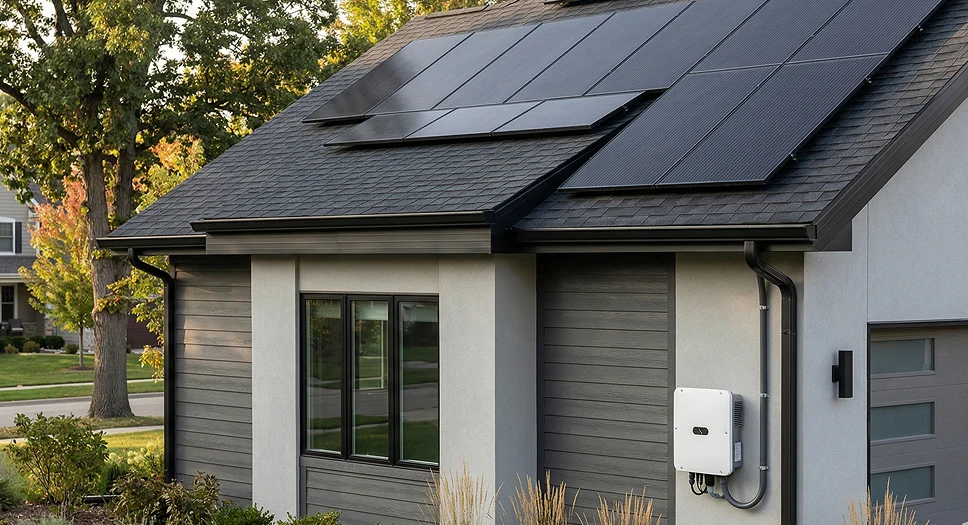
Chicagoland roofs have lots of real-world character (multiple roof planes, dormers, chimneys, and mature trees), so sunlight and partial shade naturally change throughout the day.
SolarEdge’s optimizer-based design is built for these real-world layouts because each panel can be managed individually, which helps reduce mismatch losses when one part of the array is underperforming.
Monitoring supports payback by helping you catch downtime quickly and keep savings on track. SolarEdge’s monitoring platform is designed to give system-level and module-level visibility, making it easier to spot issues early and get them fixed faster, which can improve uptime over the life of the system.
Snow season is another local reality. Snow cover can reduce production and create measurable annual energy losses depending on how often panels stay covered.
Optimizers do not “make power from snow,” but they can help in mixed conditions by reducing the impact of one covered or weakened module on the rest of the array compared with traditional series behavior.
Your payback is built on (1) the energy your system delivers in real-world conditions, (2) fast visibility and response when performance shifts, and (3) how sun exposure and seasonal weather shape output over time.
Why Trust Green Attic Roofing
Green Attic Roofing provides SolarEdge service and performance support in the Chicagoland area for systems already installed, so your investment stays protected long after energization.
We work directly with solar installers to sequence new projects correctly: roof first, panels second, no rework, no warranty gaps. If your roof is within 5–7 years of end-of-life, replacing it before your solar install protects the entire investment. Request a free roof inspection from Green Attic Roofing and go into your solar quote knowing your structure is ready.
Frequently Asked Questions
What Illinois solar tax credits and incentives can apply to a SolarEdge installation in 2026 in Chicagoland?
In 2026, a SolarEdge installation in Chicagoland can apply for strong Illinois incentives like Illinois Shines (SRECs) for upfront value, ComEd’s smart inverter/DG rebate (about $300/kW DC), and Illinois’ property tax treatment that prevents your solar system from increasing your assessed home value.
The 30% federal residential credit (Section 25D) isn’t available for new homeowner-owned systems installed in 2026, but the good news is that a 30% federal commercial credit may still apply if the project is structured as a business asset or third-party owned (lease/PPA).
What does a typical SolarEdge system cost in the Chicago suburbs (before and after incentives)?
A typical 7–10 kW SolarEdge system in the Chicago suburbs usually costs about $21,000 to $35,000+ before incentives (roughly $2.85–$3.20 per watt), and it’s a strong foundation for long-term energy savings.
After incentives like Illinois Shines (SRECs) and potential ComEd DG rebates, the net cost can drop substantially, and it may drop even further if the project is a lease/PPA or otherwise eligible for commercial federal incentives (note: the 30% federal residential credit is not available for new 2026 homeowner-owned installs).
What is a realistic Chicagoland solar payback timeline under ComEd supply-only export credits (post-2025)?
A realistic solar payback timeline for Chicagoland systems installed post-2025 under ComEd’s supply-only export credits is typically about 8–12 years, and it can be even faster when you maximize self-consumption and align system size with your daily usage.
Even with lower export credits than full retail net metering, Illinois Shines SRECs, the ComEd DG rebate, and smart sizing (and optional storage) can keep solar a strong long-term value.
Can I stack Illinois Shines SREC payments with federal incentives and ComEd credits?
Yes, you can stack Illinois Shines SREC payments with federal incentives (e.g., the 30% Investment Tax Credit, when eligible) and ComEd credits/rebates (e.g., the smart inverter rebate and ongoing bill credits).
Keep in mind that when a federal tax credit applies, some rebates may reduce the “qualified cost” used to calculate the credit, so your installer or tax professional can help you optimize the stack.
Does the Domestic Content Bonus apply to residential solar or only commercial and third-party-owned projects?
In most cases, the Domestic Content Bonus is designed for commercial or third-party-owned projects rather than standard, homeowner-owned residential rooftop solar, so homeowners can stay focused on other incentives that still deliver excellent savings.
It’s primarily available for commercial and third-party owned (lease/PPA) projects, where a business entity claims the tax credit and meets strict U.S. manufacturing thresholds, so homeowners can stay focused on the incentives that most commonly deliver savings for residential solar.